Categories
Blog

Systems Check: Deathmatch Island

Deathmatch Island doesn’t waste time. From the moment you start, you’re knee-deep in high-stakes reality TV chaos, trying to outwit, outlast, and outplay (yes, Survivor style) your fellow competitors. It’s fast, unpredictable, and leaves just enough room for strategy before things inevitably spiral into violence. If you like structured storytelling with plenty of room for improvisation, this one’s got you covered.

When it was first announced on Kickstarter and I backed it, I immediately had this vision of running an LRC-wide campaign open to anyone to join in and it would be played out in brackets of teams with maybe 2-3 Production Players running the lot through the 3 Islands into the end game. I pictured the necessity of player eliminations would whittle all players down to a single table, maybe with a mix of players.

Character Creation & Setup

Character creation is quick, messy, and full of surprises—exactly how it should be for a game like this. You roll up your occupation, skills, and some defining traits, which immediately set the tone. A gym teacher, a youth pastor, a coffee barista? Yep, that was our crew. The game leans into the absurdity of reality TV casting, and it works brilliantly.

What Stood Out:

  • Quick and engaging: You’re not spending an hour crafting a backstory. You roll, you interpret, and suddenly you’re a contestant on Deathmatch Island.
  • Random generation creates fun surprises: The combination of occupations and skills forces players into some delightfully weird roles.
  • Encourages personality-driven play: The game doesn’t tell you who to be—you decide how to make your oddball contestant shine.

Where It Could Improve:

  • Some roles felt weaker than others: A gym teacher can lean into physicality, but a business consultant? Harder to justify mechanically.
  • Initial guidance is a bit lacking: Some players weren’t sure how their chosen role factored into the game at first.

Game Flow & Mechanics

The game is split into three phases, each escalating the tension.

Phase 1: Exploration and Social Play

This is the part where you pretend everything is fine. You make alliances, gather resources, and try to figure out who’s playing what angle. In our session, we got tangled up with the Reborn—a cult convinced the island was a path to enlightenment. Some of us played along, others tried to steal their supplies, and one poor soul just wanted a cup of coffee.

✅ Strong emphasis on improvisation—One player infiltrated the cult, while another ran a long con to gain their trust.
✅ Multiple approaches feel viable—You can talk your way in, sneak around, or just grab what you need and run.
❌ Some rules felt vague—We weren’t always sure how trust and resource management worked.
❌ Stakes weren’t always clear early on—Failure felt more like a speed bump than a real setback.

Phase 2: The Scramble

Now things heat up. Alliances shift, betrayals happen, and suddenly you’re not just surviving—you’re competing. Our session saw the Alpha Alliance throwing down the gauntlet, daring us to face them in open combat. Some took the bait, others schemed from the sidelines, and one guy hid in the bushes with a shotgun.

✅ The tension ramps up naturally—You feel the stakes rise as the game shifts gears.
✅ Different playstyles all feel valid—Whether you fight, manipulate, or avoid confrontation, the game accommodates.
❌ Rules for defending vs. seizing control got murky—It wasn’t always clear how these choices impacted the larger game.
❌ Juggling multiple factions got tricky—Between the Reborn, the Alpha Alliance, and others, keeping track of alliances was a challenge.

Phase 3: The Battle Royale

This is it. The final showdown. The Alpha Alliance wanted blood, and we gave it to them. Guns, last-minute betrayals, desperate sprints for safety—it had everything. The playground-turned-warzone setting was the perfect place for the finale, with contestants swinging from jungle gyms, ducking behind slides, and fighting for their lives.

✅ A chaotic, high-stakes finish—Every decision mattered, and you felt the weight of each move.
✅ Encourages wild, last-minute plays—A grappling hook escape? A fake surrender? All fair game.
❌ Tracking injuries and advancements was clunky—Some of us weren’t sure when or how to apply certain mechanics.
❌ Weapons needed more clarity—When to use them, what risks they carried—this wasn’t always obvious.

Why This Works as a Narrative Game

  • Reality TV tropes are baked in: Confessionals, alliances, betrayals—it’s all there, and the game leans into it.
  • Characters evolve naturally: Your contestant starts as a gimmick but becomes something much more by the end.
  • The blend of humour and tension is spot on: It’s ridiculous, but it never stops being engaging.

A Wild, Thematic Ride

What’s Great:

✅ Highly thematic and immersive—From start to finish, it feels like a deadly reality TV show.
✅ Engaging and replayable—Between official content and community expansions, there’s a lot of variety.
✅ Encourages improvisation and teamwork—But still lets you play the game your way.

What Needs Work:

❌ Some mechanics need polish—Especially around trust, injuries, and resource use.
❌ Better guidance for GMs would help—Tracking factions and balancing encounters takes effort.

Deathmatch Island delivers a thrilling, unpredictable, and ridiculously fun experience. It’s got the energy of a reality show season finale—packed with twists, betrayals, and last-second heroics. With a bit more polish, it could easily hit a perfect score, but as it stands, it’s a solid 4/5. Play it, survive it, and hope you don’t get eliminated first.

Artworks featured are by Tim Denee for Evil Hat Productions.


You can also find us on these social platforms:

Categories
Blog

How Playing D&D Builds Better Teams

Back in 2019 I had the opportunity to speak at a work conference; Litmus Live London. This time around I spoke on something a bit different. To be frank, it wasn’t a serious speaking proposal – I’d put in other topics as well, but the conference team came back asking for this one. So I set out to fulfil the brief; using D&D to build better teams. Here’s the synopsis Litmus and I put together:

Every team member has strengths and weaknesses. The key to a truly effective team is understanding them and establishing a team dynamic that takes advantage of both. In this session, Jonathan Pay from Holistic Email combines two of his passions (D&D and email) to show you how a classic role-playing game can be used as a tool to examine teamwork and build a party that finally comes together to work towards the same goals.

Originally posted on jonathanpay.com

P.P.S. I’ve decided to include some of my experience with RPG on my LinkedIn given that I did a presentation on this it makes sense as there’s a lot of administration, organisation, as well as creative and reactive thinking that goes on in running an RPG campaign or being a player. I encourage all LRC members to do the same if they think it’s relevant.


You can also find us on these social platforms:

Categories
Blog

Systems Check: HEDGE

HEDGE is combat-heavy fantasy RPG set in a post-Fey apocalypse world. Its system is built on the Illuminated by LUMEN framework, and that means MMORPG- and team shooter-like gameplay: character roles, loot drops, and hordes of enemies to raze down.

You play as Wardens: undying, supernatural warriors powered by the entity known as The Hedge to fight against the Fey who have taken over the world whilst desperately holding on to your fading humanity. The flavour text for the world and characters are short yet rich, vivid, and striking, a sumptuous appetiser that complements the juicy main course: its simple and straightforward rules of engagement.

White-Knuckled Action

HEDGE is about combat and little else (well, there is an expansion with rules for building survivor settlements, but we didn’t look into that in our Systems Check session). It’s blow-by-blow, turn-by-turn. Wardens go first, then enemies retaliate.

A combat-heavy fantasy RPG will inevitably draw comparisons to Dungeons & Dragons and Pathfinder, the giants in the genre. Those games are known for having “crunchy” rules in addition to long lists of classes, weapons, armour, spells, and other customisation options.

HEDGE does not have any of that. Each Warden playbook corresponds to an archetypal role found within the video games HEDGE was inspired by (tank, damage-dealer, or support) and each has a set number of powers reinforcing that role. Weapons can take any form but have 2 attributes only. All in all, there is little build variety, and I suspect this serves to make building a synergetic party easier. The playbooks, powers, and weapon attributes are pretty balanced except in a couple of places, where certain options look glaringly stronger than others that it becomes the no-brainer choice.

On each of their turns, Wardens can do 3 things: move, activate a power, make a weapon attack or interact with the environment (in no particular order). Weapon attacks must be rolled for with d6s — there is a ⅔ or better chance of hitting any enemy — but powers always work no matter what. Wardens also have a passive power and a “Fade” power which activates when they are knocked down to 0 HP, supporting their teammates from beyond the grave (though not for long — fallen Wardens always get revived eventually).

The first pages of character creation in HEDGE.

As for enemies, there are 4 classes of foes, ranging from squishies to boss monsters. Squishies do little damage and are usually killed in one hit, boss monsters have a big HP bar and deadlier, more varied moves, etc. (If you play video games, you know this goes.) Enemies do not need to roll for attacks, they can always deal damage, and the vague descriptions of their unique abilities can be interpreted however the GM wishes. Killing enemies begets Wardens health points, “Fate” points to fuel their powers, or — very occasionally — “Grafts”. Grafts are rare loot from fallen Fey that can, as the name suggests, be grafted onto a Warden’s body to grant them one of that Fey’s abilities at the expense of their humanity.

This overall lack of rolling is what gives the game its fast and punchy combat, in stark contrast to combat in D&D and Pathfinder which can often get bogged down in complicated rules and waiting for roll results. Characters feel like absolute badasses in a power fantasy as they mow down foe after foe, standing against hordes of hostiles like rocks breaking the waves. One adjustment I made to the rules for even faster momentum was to roll for loot drops immediately after an enemy is killed and have the loot automatically go to the Warden who got the final blow, unless the player states otherwise.

That all worked very well in the session. What didn’t work so well was how HEDGE does maps and distance. Where D&D and Pathfinder use grids with discrete distance measurements for battle maps, HEDGE uses range bands and vague distance markers like “near” and “far”, which our table found to be vexing and confusing at times, even slowing down the momentum of combat as we puzzle over how things would work. One player pointed out that range bands on a map ought to be combined with character tokens also having their individual range bands, but at that point, why not just use a regular grid? This, along with a lack of rules for doing extra movement on a turn, forced me to play fast and loose with the written rules and hand-wave stuff on the fly.

An example map with range bands overlaid, by A Couple of Drakes.

Final Thoughts

HEDGE feels like the light popcorn alternative to crunchier games in the same niche. A GM doesn’t need to prep much — just grab a random combination of enemies from the book and throw them at the players. Not having to deal with complex statblocks and lair actions and whatnot can be freeing.

However, HEDGE‘s lack of polish is what keeps it from being truly great. There are some vague and confusing terminologies in the book — the absence of definitions for “combat”, “battle”, and “wave” misled me to believe that fallen Wardens revive only after the fighting has stopped instead of in between waves of enemies (oops); it desperately needs a glossary and a table of contents. And clarification on how range bands work, and how extra movement can be ruled, and others…

HEDGE brings fresh ideas to the table that are a welcome change of pace from crunchier fantasy combat games. Does it threaten to rival or unseat the more refined and established titles in the genre? No, but that’s no reason to pass on it.

Cover art by Artem Demura


You can also find us on these social platforms:

Categories
Blog

Systems Check: Solemn Vale

Solemn Vale is a narrative-based RPG that sets out to emulate the eerie, slow-burn horror feel of British folk horror cinema from the 1970s. Think The Wicker Man, Blood on Satan’s Claw, Children of the Stones, and The Owl Service. (Naturally, the game also takes inspiration from more modern folk horror works such as Midsommar, The Witch, Ben Wheatley’s entire filmography, and yes, Hot Fuzz.)

Set in the fictional Devon town of Solemn Vale during that bleak decade, you play as outsiders who were drawn to this seemingly idyllic, middle-of-nowhere town for one reason or another. In a Systems Check session, we played the story “Footprints” from the free standalone rules — which functions as a sort of quickstart for the game — in which the players step into the role of a BBC production crew about to interview a lucky young resident of Solemn Vale. But what they found instead was an empty, shambolic house and the snare of the Wyrd…

The Wyrd Abacus

Solemn Vale‘s game system is officially called The Wyrd Abacus. In contrast to the evocatively-written setting, our table found the text explaining the rules to be bloated and difficult to grasp despite the actual rules themselves being relatively simple, even almost bare-bones compared to some of its peers in the horror RPG genre. The system boils down to this:

You have 3 attributes: Body, Mind, and Soul. You have a pool of points in each attribute. When you encounter a challenge, you spend a number of points from the relevant attribute and add that number to a d6 roll. If your total result meets or exceeds the Challenge Value set by the GM, you succeed at overcoming the challenge. Irrespective of success or failure, the number of points you chose to spend on that roll are deducted from the attribute’s pool. This mechanic is called a Challenge Roll and it’s the most frequent thing you will do in a session of Solemn Vale (though there are other types of rolls in the game too); it can be done either individually for each character or as a group, where all members of the group can contribute points towards the single d6 roll.

If you fail a Challenge Roll, worry not — you can draw from a separate pool of points called the Scene Wyrd Pool to add to the result until it meets the Challenge Value. It’s a finite resource attached to every scene in the story, a number of points equal to the number of players at the table plus one, refilled with each new scene. Whenever a character draws Wyrd Points from the Scene Wyrd Pool, they also add an equal number of points to their own Personal Wyrd Pool. The text suggests representing Wyrd with something physical and tactile, like a bowl of beads that players can take from (as we played online, I had to settle for a digital version of that using movable tokens).

The Wyrd Abacus’ simple, minimalistic character sheet.

Wyrd is the Anglo-Saxon concept of fate or personal destiny. The name implies that using Wyrd Points is akin to manipulating the forces of destiny in order to alter events to one’s advantage. However — to paraphrase a line from Netflix’s The Midnight Club — the more you pull on the rubber band of fate, the harder it snaps back at you.

At certain times during a scene, triggered by specific actions of player characters, the GM will call for a character or multiple to do a Wyrd Roll. They roll a number of d6s equal to the number of points they’ve accumulated in their Personal Wyrd Pool and take the highest result. A low result (1 or 2) may anchor the character back to mundane reality; for instance, they may discover that the unsettling noises coming from the walls were caused by nothing more than faulty pipes. But on a result of 6, the character attracts the unwanted attention of the supernatural or the malevolent — a poltergeist dogs them with vicious pranks, a masked cultist begins stalking them from the shadows, or worse.

The Wyrd mechanic enriches the dark atmosphere and force-feeds the characters’ growing paranoia. This is where Solemn Vale excels — the rules are perfect for creating atmospheric, slow-creeping horror that builds towards a grippingly tense climax. Either that rubber band will break, or you will. The players at my table agreed that the optimal way to play would be to lean into the role of the outsider: playing characters who are sceptical of the occult and/or turned off by the locals’ rural quirks, just so the Wyrd could mess with their heads even more.

As the story progresses, the challenges become harder and failure is increasingly punished; the characters will accrue damage to their Body, Mind, and Soul, docking off points from those attributes. If an attribute is reduced to 0 points due to damage, it is “scratched out”. If a character scratches out an attribute twice, they are dead or defeated — their body, mind, or soul having been broken. This can happen quicker than you’d expect; Solemn Vale is a game designed for short-term play.

This simple mechanic of gradually-decreasing attribute points is effective at creating tension and stress in the player, and that’s all Solemn Vale really needs. Unlike other RPGs, it does not use an independent meter to track a character’s health or sanity; since characters are entirely mundane people, their ability to overcome challenges is inseparably tied to their well-being. Unlike its horror RPG peers, it does not rely on intimidating statblocks or rollable tables of madness to craft a terrifying scenario. None of the threats in Solemn Vale have statblocks — they are all unconquerable forces of nature, as they should be.

Final Thoughts

Everyone in this Systems Check session gave glowing reviews for Solemn Vale, praising how the simple mechanics effectively reinforced the atmosphere of creeping dread, bewilderment, and tension as seen in folk horror movies. One player compared it favourably to Dread, the Jenga-based horror RPG.

From the GM side of the screen, I appreciated the tools Dirty Vortex gave us to create the right atmosphere and feel, particularly via the Stage Rules mechanic. Stage Rules are hidden rules tailored to the story or specific scenes within the story. (Taking an example from “Footprints”, in a scene set in the woods: “Failed Body and Mind challenges at this location inflict 1 Body damage in addition to all other consequences, as branches scratch, feet get caught in bracken and characters trigger animal traps.”) As one of my players pointed out, writing an original story for Solemn Vale is easy with this framework: choose a threat, create a three-act structure around that threat, and then come up with thematically-relevant Stage Rules for each scene.

If you’re looking for an alternative to Call of Cthulhu or Vaesen, we highly recommend checking out Solemn Vale.

Artworks featured are by Mark Kelly for Dirty Vortex.


You can also find us on these social platforms:

Categories
Blog

Against the Horde!

LRC members test their D&D combat skills against endless tides of monstrous foes! Led by DM Jonny, players Youki, Hailey, Morgan, and Will try to survive for as long as they can and kill as many as they can on a livestreamed game of MCDM’s “Against the Horde”.

Originally streamed on Twitch, we uploaded the stream to YouTube for posterity.

Check out where we placed on the Against the Horde leaderboard. Can your party beat our score?

Cover art by Martin Sobr


You can also find us on these social platforms:

Categories
Blog

Together @ Home

As London is gripped by the COVID-19 pandemic, the London RPG Community had little choice but to move its games online after pubs and gaming cafés close their doors for the safety of everyone. As we became aware that many of our members would be spending Easter at home with naught to do, the LRC decided to organise a four-day online RPG convention over the long Easter weekend, hosting a boat-load of games from various systems at our Discord server to keep people from getting bored. And thus, the first ever Together @ Home was born.

We saw a total of 21 games being played over the 4-day weekend, most of which were at full capacity that 2 more games had to be added to the initial line-up in order to accommodate more players. We drew in more interested gamers to our community and we met many other RPG enthusiasts, some of whom are scattered across the globe, from the safety of their own homes.

Here’s the full list of the RPG systems that were played during the first Together @ Home:

  • Alien RPG
  • Delta Green
  • Dialect
  • Dungeons & Dragons 5e
  • Heart: The City Beneath
  • Into the Yonceverse
  • Lasers & Feelings
  • Powered by the Apocalypse (Demigods, Dungeon World, Masks, Monsterhearts 2, The Sprawl, and two homebrewed hacks of PbtA by our members called Smooth Sailing and Hogwarts: A Pisstake)
  • Savage Worlds

Together @ Home had a fantastic reception from our members and we are certain to hold more of these conventions as lockdown continues, with even more RPGs to try.


You can also find us on these social platforms:
Categories
Blog

Nuno’s Session Theory

One of our (once) resident Game Masters, Nuno Teixera, developed this simple formula for plotting out a 3-hour game session — it’s his not-so-secret to running games!

Although it was originally created for Kantas games, it is generic and universal enough to suit most RPG systems, with or without combat. So, let’s get to it:

Summary

You will need to prepare:

1 Concept
2 to 3 Obstacles
3 Locations/Stages

Concept

The starting premise of your game. Can either be player-facing or not. Just needs to be something to get your creative juices flowing.

Example of player-facing concept:

“This village is very creepy and you are here to investigate.”

Example of non-player-facing concept:

“You are in a village.” – The village is very creepy and they don’t know.

Other types of concepts can be: Monsters, an NPC, a magic item, etc. Everything works as long as you can build a story around it.

Locations/Stages

These are the pivotal points of your story and are moments you should pause the narrative timeline to describe/explain what’s going on.

Examples: An abandoned house, an NPC walking into the tavern, reaching a haunted clearing, etc.

For an extra kick you can prepare more stages/locations to give the players real choices. This is not necessary as long as they have the illusion of choice – that’s what matters for it to be an enjoyable, immersive experience.

Obstacles

Your classic conundrums.

Examples: Combat encounter, puzzles, negotiations, a lengthy story exposition, interrogations, etc.

As a rule of thumb if you choose to have 2 combat encounters as obstacles, you probably won’t have time for the 3rd Obstacle. If you choose to have only 1 combat encounter then more often than not you’ll end up needing the 3rd Obstacle.

Prepare an extra Obstacle that can easily be included before your climactic Obstacle, in case your players blitz through everything.

Endnotes

This is a formula that works for me, with players engaging in average to low amounts of RP. If your players start RP immediately and do it often, be prepared to cut locations/stages or obstacles.

Even if you don’t prepare for multiple choices/different outcomes, always give the players the illusion of choice. They will never know there was no alternative outcome.

If you know your players well, use this as a skeleton and cut/add sections depending on their gameplay style! If you’re DMing for strangers/new players I’m pretty confident this will work out for you.

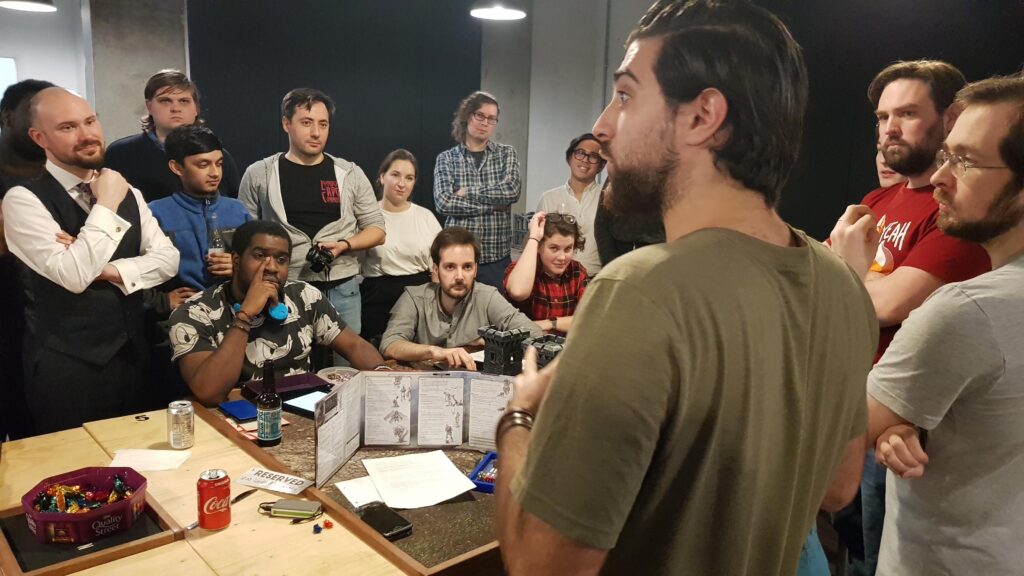
Nuno DM-ing a Kantas season finale at the Bad Moon Café (central London), June 2019.

Follow Nuno on Twitter and check out his games on itch.io.


You can also find us on these social platforms:

Categories
Blog

Alien: Chariot of the Gods

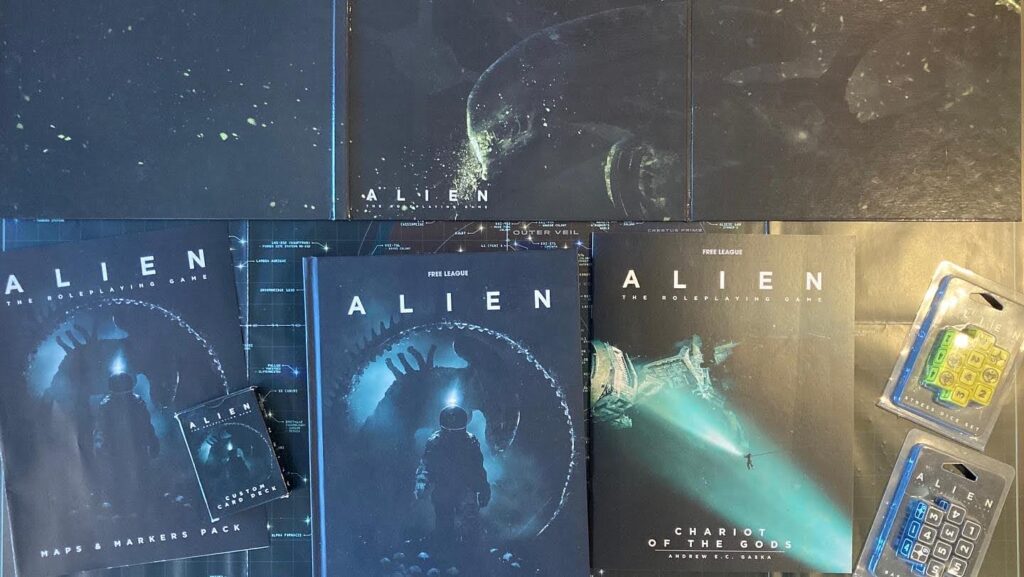
June 2019, the Cinematic Starter Kit PDF for the recently announced Alien RPG from Free League Publishing has reached my inbox and I’m preparing to run it.

With a handful of keen players we ran through the scenario in just over 4 hours. The tension was palpable at the table. One of the players, Ian, did an in character write up of the cinematic, which is linked below. I then jazzed it up to fit the Alien RPG look and feel.

I fell in love with Free League’s games when another member, Josh, got ahold of Coriolis: The Third Horizon and ran the quickstart a couple of times before creating his own mini campaign aboard a prison space ship that I played in.

When Free League announced that they were making an Alien RPG I was immediately excited and pre-ordered right away, and I was in no way disappointed. I’ve since run “Hope’s Last Day”, the one act scenario in the core rulebook more than few times and not tired of it – each group of players takes the same pre-made characters in a unique direction each time.

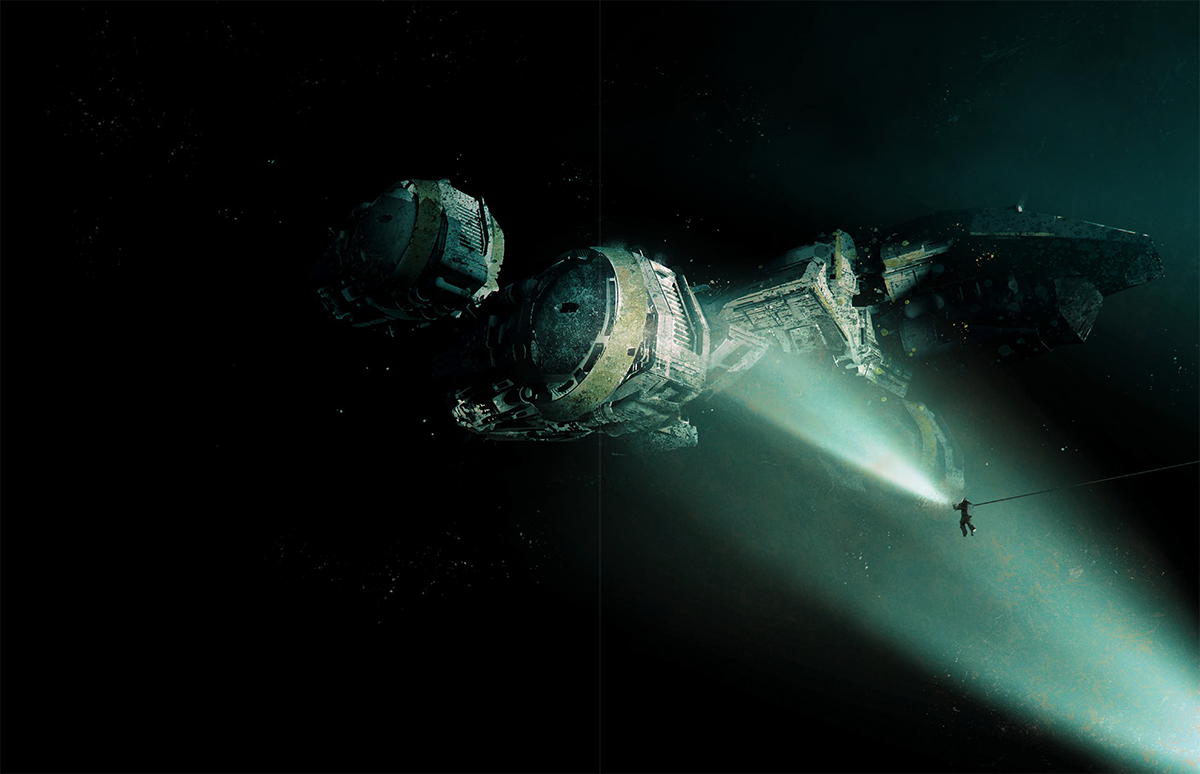
Cover art by Martin Grip for Free League Publishing


You can also find us on these social platforms:

Categories
Blog

On The Shores of Kantas

An actual play & interview of London RPG Community put together by Kalum from Rolistes Podcast featuring Andy, Nuno, Dasha, and Riah. Each episode is about an hour long and includes interviews mixed throughout the session’s plot.

Part 1

Released 14 November 2019

Part 2

Released 28 December 2019

Part 3

Released 21 February 2020

Part 4

Released 27 April 2020

A very special thank you to Kalum from The Rolistes Podcast for putting this together and featuring our community!


You can also find us on these social platforms: