Categories
Blog

Systems Check: HEDGE

HEDGE is combat-heavy fantasy RPG set in a post-Fey apocalypse world. Its system is built on the Illuminated by LUMEN framework, and that means MMORPG- and team shooter-like gameplay: character roles, loot drops, and hordes of enemies to raze down.

You play as Wardens: undying, supernatural warriors powered by the entity known as The Hedge to fight against the Fey who have taken over the world whilst desperately holding on to your fading humanity. The flavour text for the world and characters are short yet rich, vivid, and striking, a sumptuous appetiser that complements the juicy main course: its simple and straightforward rules of engagement.

White-Knuckled Action

HEDGE is about combat and little else (well, there is an expansion with rules for building survivor settlements, but we didn’t look into that in our Systems Check session). It’s blow-by-blow, turn-by-turn. Wardens go first, then enemies retaliate.

A combat-heavy fantasy RPG will inevitably draw comparisons to Dungeons & Dragons and Pathfinder, the giants in the genre. Those games are known for having “crunchy” rules in addition to long lists of classes, weapons, armour, spells, and other customisation options.

HEDGE does not have any of that. Each Warden playbook corresponds to an archetypal role found within the video games HEDGE was inspired by (tank, damage-dealer, or support) and each has a set number of powers reinforcing that role. Weapons can take any form but have 2 attributes only. All in all, there is little build variety, and I suspect this serves to make building a synergetic party easier. The playbooks, powers, and weapon attributes are pretty balanced except in a couple of places, where certain options look glaringly stronger than others that it becomes the no-brainer choice.

On each of their turns, Wardens can do 3 things: move, activate a power, make a weapon attack or interact with the environment (in no particular order). Weapon attacks must be rolled for with d6s — there is a ⅔ or better chance of hitting any enemy — but powers always work no matter what. Wardens also have a passive power and a “Fade” power which activates when they are knocked down to 0 HP, supporting their teammates from beyond the grave (though not for long — fallen Wardens always get revived eventually).

The first pages of character creation in HEDGE.

As for enemies, there are 4 classes of foes, ranging from squishies to boss monsters. Squishies do little damage and are usually killed in one hit, boss monsters have a big HP bar and deadlier, more varied moves, etc. (If you play video games, you know this goes.) Enemies do not need to roll for attacks, they can always deal damage, and the vague descriptions of their unique abilities can be interpreted however the GM wishes. Killing enemies begets Wardens health points, “Fate” points to fuel their powers, or — very occasionally — “Grafts”. Grafts are rare loot from fallen Fey that can, as the name suggests, be grafted onto a Warden’s body to grant them one of that Fey’s abilities at the expense of their humanity.

This overall lack of rolling is what gives the game its fast and punchy combat, in stark contrast to combat in D&D and Pathfinder which can often get bogged down in complicated rules and waiting for roll results. Characters feel like absolute badasses in a power fantasy as they mow down foe after foe, standing against hordes of hostiles like rocks breaking the waves. One adjustment I made to the rules for even faster momentum was to roll for loot drops immediately after an enemy is killed and have the loot automatically go to the Warden who got the final blow, unless the player states otherwise.

That all worked very well in the session. What didn’t work so well was how HEDGE does maps and distance. Where D&D and Pathfinder use grids with discrete distance measurements for battle maps, HEDGE uses range bands and vague distance markers like “near” and “far”, which our table found to be vexing and confusing at times, even slowing down the momentum of combat as we puzzle over how things would work. One player pointed out that range bands on a map ought to be combined with character tokens also having their individual range bands, but at that point, why not just use a regular grid? This, along with a lack of rules for doing extra movement on a turn, forced me to play fast and loose with the written rules and hand-wave stuff on the fly.
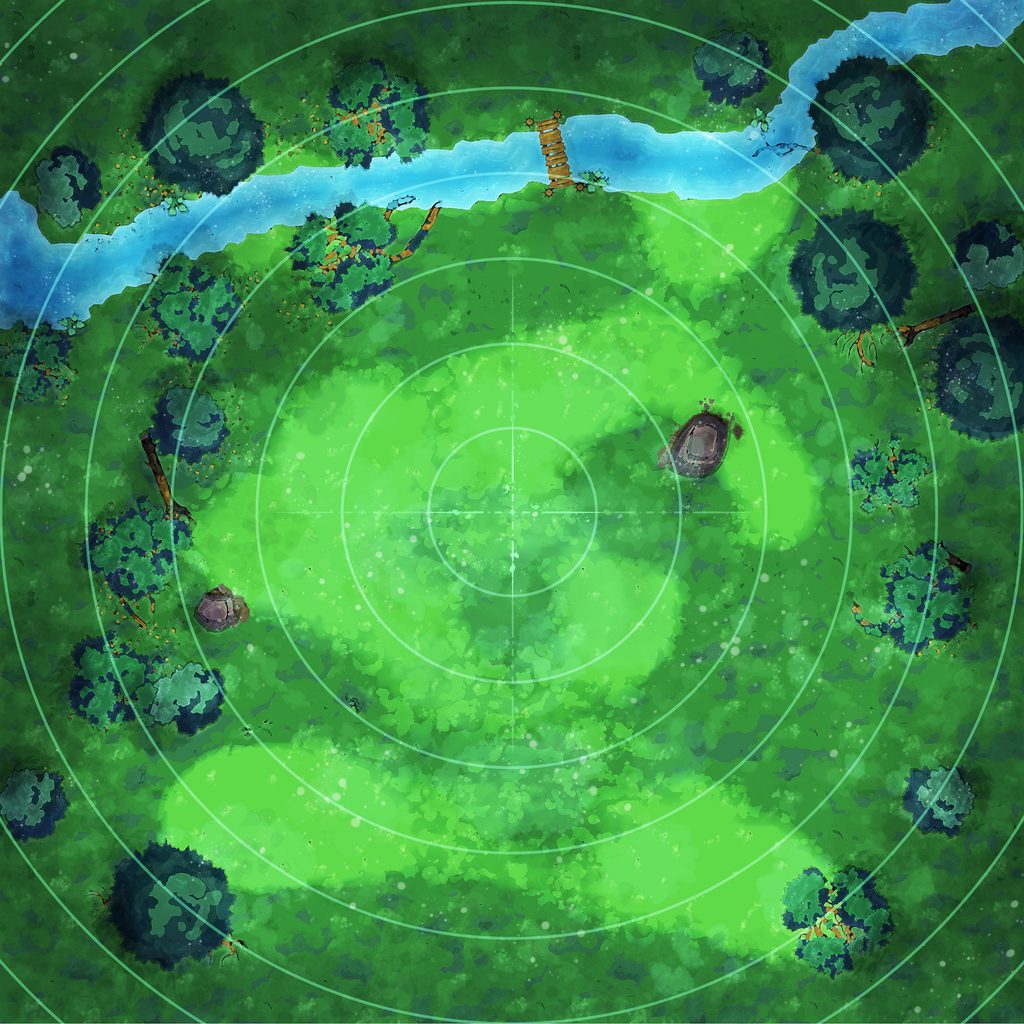
An example map with range bands overlaid, by A Couple of Drakes.

Final Thoughts

HEDGE feels like the light popcorn alternative to crunchier games in the same niche. A GM doesn’t need to prep much — just grab a random combination of enemies from the book and throw them at the players. Not having to deal with complex statblocks and lair actions and whatnot can be freeing.

However, HEDGE‘s lack of polish is what keeps it from being truly great. There are some vague and confusing terminologies in the book — the absence of definitions for “combat”, “battle”, and “wave” misled me to believe that fallen Wardens revive only after the fighting has stopped instead of in between waves of enemies (oops); it desperately needs a glossary and a table of contents. And clarification on how range bands work, and how extra movement can be ruled, and others…

HEDGE brings fresh ideas to the table that are a welcome change of pace from crunchier fantasy combat games. Does it threaten to rival or unseat the more refined and established titles in the genre? No, but that’s no reason to pass on it.

Cover art by Artem Demura


You can also find us on these social platforms:

Categories
Blog

Systems Check: Solemn Vale

Solemn Vale is a narrative-based RPG that sets out to emulate the eerie, slow-burn horror feel of British folk horror cinema from the 1970s. Think The Wicker Man, Blood on Satan’s Claw, Children of the Stones, and The Owl Service. (Naturally, the game also takes inspiration from more modern folk horror works such as Midsommar, The Witch, Ben Wheatley’s entire filmography, and yes, Hot Fuzz.)

Set in the fictional Devon town of Solemn Vale during that bleak decade, you play as outsiders who were drawn to this seemingly idyllic, middle-of-nowhere town for one reason or another. In a Systems Check session, we played the story “Footprints” from the free standalone rules — which functions as a sort of quickstart for the game — in which the players step into the role of a BBC production crew about to interview a lucky young resident of Solemn Vale. But what they found instead was an empty, shambolic house and the snare of the Wyrd…

The Wyrd Abacus

Solemn Vale‘s game system is officially called The Wyrd Abacus. In contrast to the evocatively-written setting, our table found the text explaining the rules to be bloated and difficult to grasp despite the actual rules themselves being relatively simple, even almost bare-bones compared to some of its peers in the horror RPG genre. The system boils down to this:

You have 3 attributes: Body, Mind, and Soul. You have a pool of points in each attribute. When you encounter a challenge, you spend a number of points from the relevant attribute and add that number to a d6 roll. If your total result meets or exceeds the Challenge Value set by the GM, you succeed at overcoming the challenge. Irrespective of success or failure, the number of points you chose to spend on that roll are deducted from the attribute’s pool. This mechanic is called a Challenge Roll and it’s the most frequent thing you will do in a session of Solemn Vale (though there are other types of rolls in the game too); it can be done either individually for each character or as a group, where all members of the group can contribute points towards the single d6 roll.

If you fail a Challenge Roll, worry not — you can draw from a separate pool of points called the Scene Wyrd Pool to add to the result until it meets the Challenge Value. It’s a finite resource attached to every scene in the story, a number of points equal to the number of players at the table plus one, refilled with each new scene. Whenever a character draws Wyrd Points from the Scene Wyrd Pool, they also add an equal number of points to their own Personal Wyrd Pool. The text suggests representing Wyrd with something physical and tactile, like a bowl of beads that players can take from (as we played online, I had to settle for a digital version of that using movable tokens).

The Wyrd Abacus’ simple, minimalistic character sheet.

Wyrd is the Anglo-Saxon concept of fate or personal destiny. The name implies that using Wyrd Points is akin to manipulating the forces of destiny in order to alter events to one’s advantage. However — to paraphrase a line from Netflix’s The Midnight Club — the more you pull on the rubber band of fate, the harder it snaps back at you.

At certain times during a scene, triggered by specific actions of player characters, the GM will call for a character or multiple to do a Wyrd Roll. They roll a number of d6s equal to the number of points they’ve accumulated in their Personal Wyrd Pool and take the highest result. A low result (1 or 2) may anchor the character back to mundane reality; for instance, they may discover that the unsettling noises coming from the walls were caused by nothing more than faulty pipes. But on a result of 6, the character attracts the unwanted attention of the supernatural or the malevolent — a poltergeist dogs them with vicious pranks, a masked cultist begins stalking them from the shadows, or worse.

The Wyrd mechanic enriches the dark atmosphere and force-feeds the characters’ growing paranoia. This is where Solemn Vale excels — the rules are perfect for creating atmospheric, slow-creeping horror that builds towards a grippingly tense climax. Either that rubber band will break, or you will. The players at my table agreed that the optimal way to play would be to lean into the role of the outsider: playing characters who are sceptical of the occult and/or turned off by the locals’ rural quirks, just so the Wyrd could mess with their heads even more.

As the story progresses, the challenges become harder and failure is increasingly punished; the characters will accrue damage to their Body, Mind, and Soul, docking off points from those attributes. If an attribute is reduced to 0 points due to damage, it is “scratched out”. If a character scratches out an attribute twice, they are dead or defeated — their body, mind, or soul having been broken. This can happen quicker than you’d expect; Solemn Vale is a game designed for short-term play.

This simple mechanic of gradually-decreasing attribute points is effective at creating tension and stress in the player, and that’s all Solemn Vale really needs. Unlike other RPGs, it does not use an independent meter to track a character’s health or sanity; since characters are entirely mundane people, their ability to overcome challenges is inseparably tied to their well-being. Unlike its horror RPG peers, it does not rely on intimidating statblocks or rollable tables of madness to craft a terrifying scenario. None of the threats in Solemn Vale have statblocks — they are all unconquerable forces of nature, as they should be.

Final Thoughts

Everyone in this Systems Check session gave glowing reviews for Solemn Vale, praising how the simple mechanics effectively reinforced the atmosphere of creeping dread, bewilderment, and tension as seen in folk horror movies. One player compared it favourably to Dread, the Jenga-based horror RPG.

From the GM side of the screen, I appreciated the tools Dirty Vortex gave us to create the right atmosphere and feel, particularly via the Stage Rules mechanic. Stage Rules are hidden rules tailored to the story or specific scenes within the story. (Taking an example from “Footprints”, in a scene set in the woods: “Failed Body and Mind challenges at this location inflict 1 Body damage in addition to all other consequences, as branches scratch, feet get caught in bracken and characters trigger animal traps.”) As one of my players pointed out, writing an original story for Solemn Vale is easy with this framework: choose a threat, create a three-act structure around that threat, and then come up with thematically-relevant Stage Rules for each scene.

If you’re looking for an alternative to Call of Cthulhu or Vaesen, we highly recommend checking out Solemn Vale.

Artworks featured are by Mark Kelly for Dirty Vortex.


You can also find us on these social platforms: